
Bosun Beta - Better tasks, deeper integrations, bigger migrations
Bosun's latest update brings a stronger task editor, richer GitHub, Jira, and Sentry integrations, and a clearer path from task setup to useful output.
I started Bosun because I think too much engineering time still disappears into technical debt.
Some of that work is small and constant: triage, bug fixes, dependency updates that should be routine but somehow never are. Some of it is much bigger: legacy migrations that stay on the roadmap for months because they are risky, messy, and hard to prioritize.
Over the last weeks, we have been pushing Bosun forward on both ends of that problem. The product is getting better at the everyday maintenance work teams want off their plate, and we are learning a lot from pilots on larger migrations at the same time.
Building tasks got much easier
The biggest product shift is in the task-building experience.
We shipped a stronger visual editor, moved editing into a roomier drawer flow, and added direct editing for task names, descriptions, and step identifiers. That sounds small on paper, but it makes a real difference when you are shaping larger tasks and need to stay oriented.
We also added built-in guidance for tools and toolboxes right inside the editor, plus tree selection for larger tool catalogs. The editor should help you make decisions while you build, not send you off to docs every five minutes.
A few concrete upgrades here:
- Feedback is now a first-class task node, which makes review loops much easier to build.
- Tasks can now end in multiple valid places, instead of forcing awkward ending patterns.
- Typed JSON values are preserved in templated task fields.
- Structured and nested templating is now validated more cleanly.
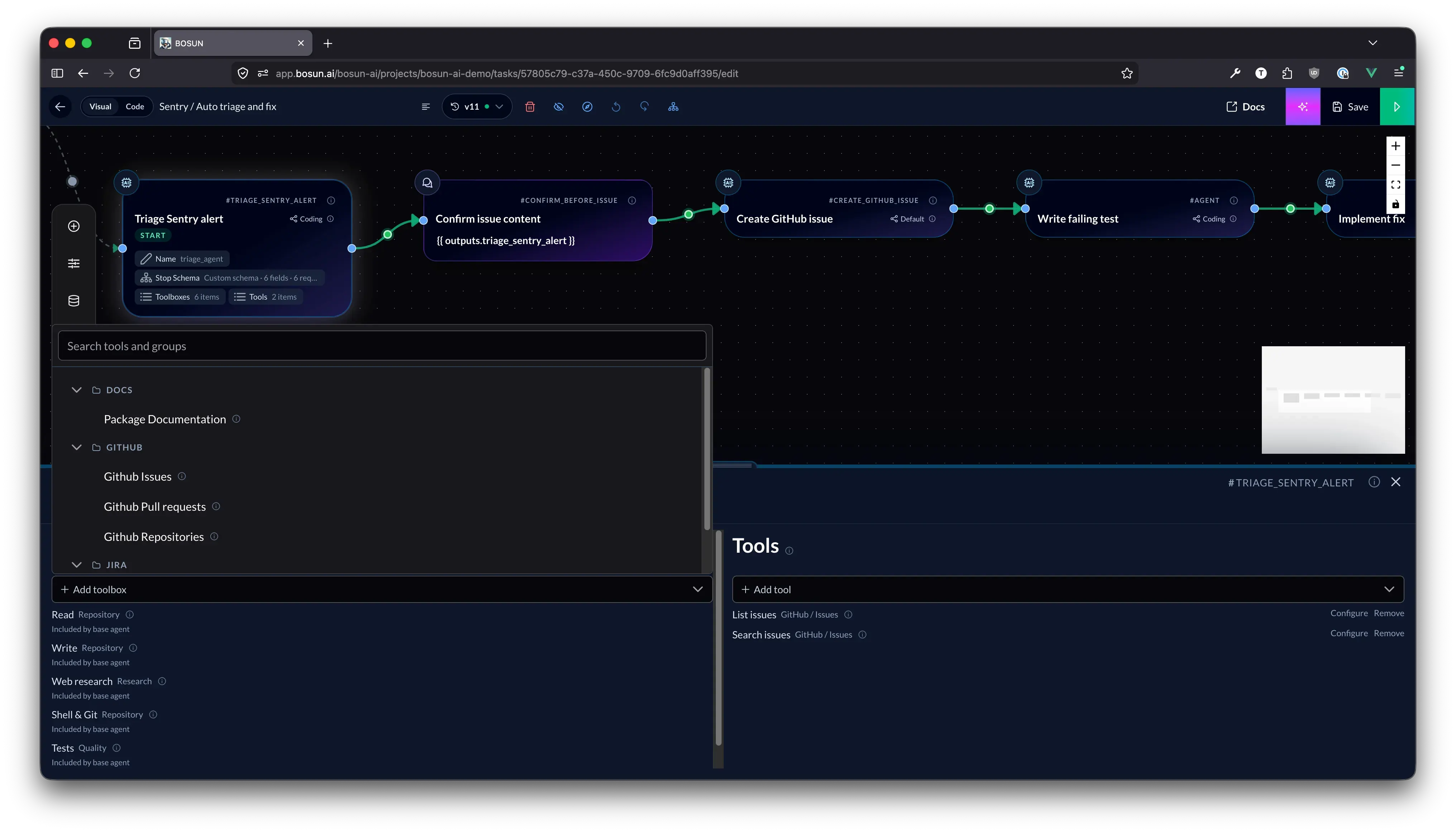
The task editor now gives you more room to shape tasks, with guidance where you need it.
Bosun is connecting more naturally to the stack
The second big area is integration depth.
We expanded triggers and conditions so tasks can react more precisely to real events. That includes better matching rules like starts with, ends with, contains, and match conditions, plus stronger support for tasks that start from different repository contexts.
We also deepened Bosun’s integrations across the systems engineering teams already use every day:
- Sentry can now trigger tasks directly, and agents can work with that context more naturally.
- Jira now has a dedicated toolbox for agent-driven interaction.
- GitHub support keeps getting broader, with more native tools, reactions, and clearer issue references.
- Explore has become a better place to discover tasks, reusable building blocks, and documentation-oriented task patterns.
Bosun should feel less like a separate system you have to learn around, and more like a natural extension of the systems your team already works in.
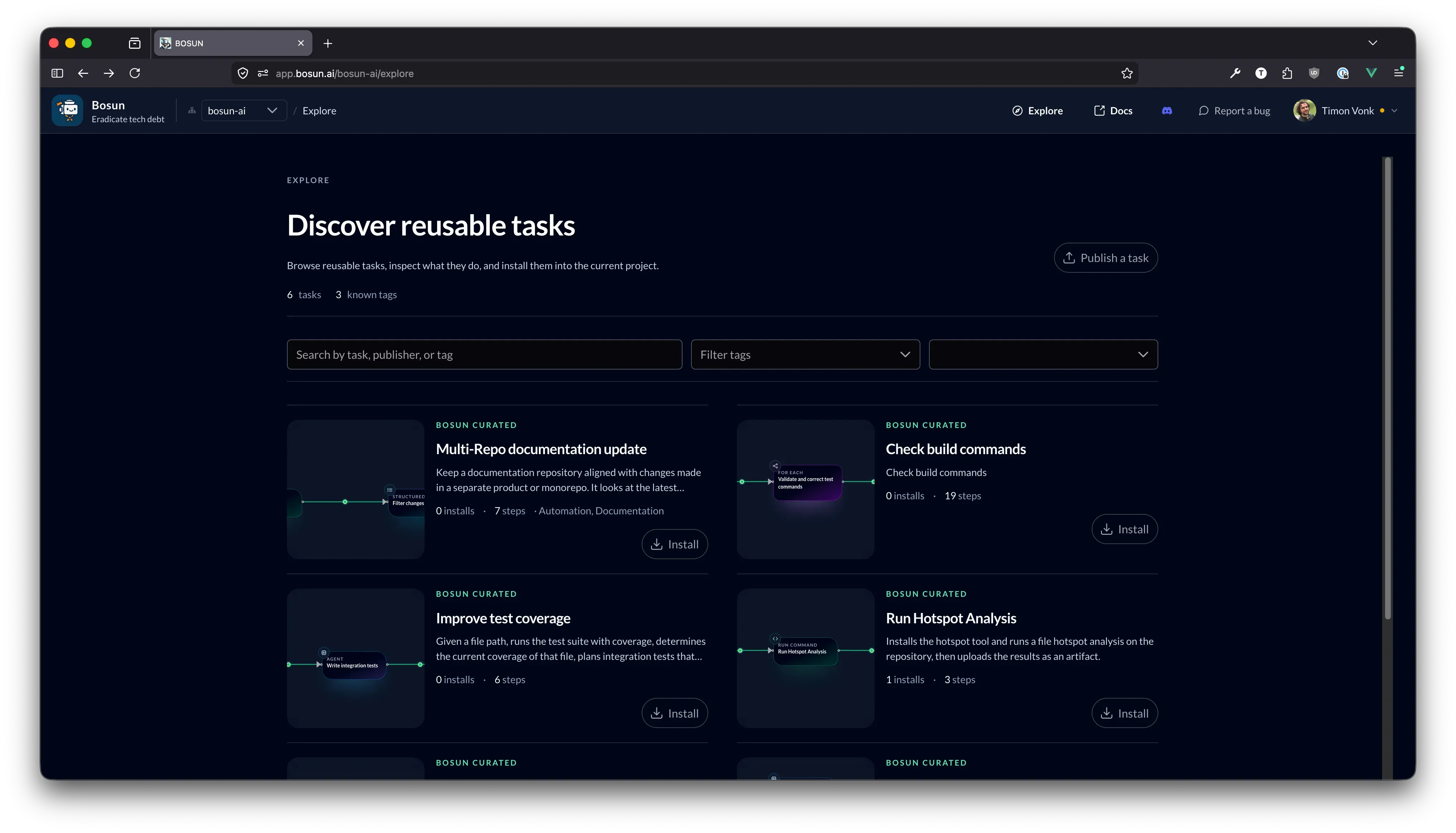
Explore is becoming a better surface for discovering tasks and building blocks that teams can actually use.
What this now unlocks
This is the part I care about most. These are not just nicer building blocks. They open the door to better day-to-day maintenance tasks.
- A Sentry-triggered task can pick up a production issue, gather context, and route the right follow-up work.
- A dependency task can pick up a failed dependabot upgrade and autonomously create a new, passing pull request.
- A review-heavy task can pause for feedback, resume cleanly, and carry GitHub or Jira context through the process.
- A documentation task triggering on release, that reviews the changelog, deeply researches, and presents a pull request in a separate documentation repository.
That is the shape of Bosun we want: tasks that are useful on their own, but become much more powerful once they are connected to the rest of your stack.
Over the next months we will be adding more and more pre-built tasks to Explore, which we dogfood ourselves. Users can publish tasks too!
Running tasks feels better too
We also spent time on what happens after a task starts running.
Task outputs are easier to inspect with analysis visualizations. Feedback and session flows are cleaner. Resume behavior is more consistent. Even older session messages are easier to surface when you need the full story.
Under the hood, we also raised the ceiling on what Bosun can take on. Tasks now run in more isolated environments, source control pushes retry more intelligently, and the overall path from setup to output feels more continuous.
Small tasks matter. Bigger migrations do too
A lot of the value in Bosun today comes from high-leverage SDLC automations: auto-fixing bugs, triage, and dependency updates that are always a little trickier than they first appear.
But we are also learning from the other end of the spectrum.
We are working with pilot teams on larger legacy migrations, and that is shaping the product in a very direct way. It forces us to think beyond isolated automations and toward longer-running, higher-stakes technical debt work that needs better context, better task design, and better execution.
That is where this gets interesting to me.
Bosun should be useful for the work that lands on your desk every day. But it should also help teams make progress on the bigger technical debt they usually leave untouched for too long.
Closed beta
Bosun is still in closed beta, and we are sending more invites as we go.
If technical debt is a problem you care about too, there are a few easy ways to follow along or reach out:
- Join the mailing list: Subscribe on bosun.ai for product updates and new invite waves.
- Reach out on social: Talk to us on LinkedIn if you are dealing with maintenance, migrations, or messy dependency work.
- Join Discord: Come by the Bosun Discord if you want to follow along more closely.
Timon Vonk
Co-founder & CTO, Bosun
linkedin.com/in/timonv